Reducing Fall Risk in Senior Living With an Objective Record
.png)
Brian Geyser, APRN-BC, MSN, is Head of Clinical Innovation at Inspiren, where he partners across teams to bring clinical insight into every layer of the company’s technology and strategy. With more than 30 years of experience at the intersection of senior living, healthcare operations, and innovation, Brian has long focused on transforming care for older adults. He previously served as Vice President of Enterprise Intelligence at Maplewood Senior Living, where he led AI and analytics initiatives and was an early adopter of Inspiren’s technology. Today, he plays a key role in advancing Inspiren’s mission to deliver measurable outcomes and operational confidence through a more connected, insight-driven approach to care.
Why Are Falls Such a High-Stakes Liability Issue?
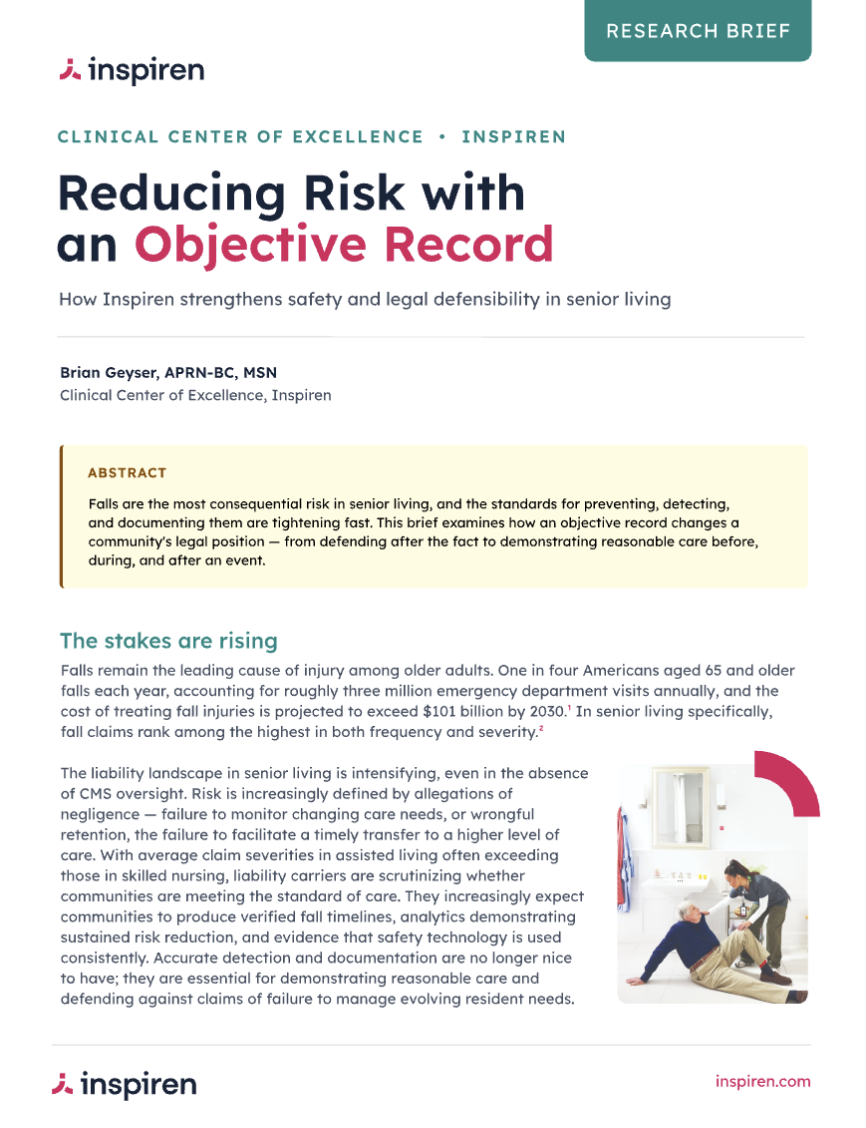
Falls are the leading cause of injury among older adults. One in four Americans aged 65 and older falls each year. That adds up to roughly three million emergency department visits annually, and the cost of treating fall injuries is projected to exceed $101 billion by 2030. In senior living specifically, fall claims rank among the highest in both frequency and severity.
The liability landscape is intensifying, even without CMS oversight. Risk in senior living is increasingly defined by allegations of negligence: failure to monitor changing care needs, or wrongful retention (the failure to move a resident to a higher level of care when they need it). Average claim severities in assisted living often exceed those in skilled nursing. Liability carriers are scrutinizing whether communities meet the standard of care. They expect communities to produce verified fall timelines, analytics showing sustained risk reduction, and proof that safety technology is used consistently. Accurate detection and documentation are no longer "nice to have." They are essential for demonstrating reasonable care.
What Makes an Objective Record the New Standard of Care?
An objective record is a timestamped, technology-verified account of when a care event occurred, when the care team was alerted, and how they responded. It is quickly becoming the standard of reasonable care in senior living.
Liability turns on one question: did the community exercise reasonable care? Increasingly, the answer depends on whether it used the tools reasonably available to anticipate, respond to, and document what happened. Deploying fall technology and acting on its data helps show that a community is using every reasonable tool available to protect its residents.
This technology shifts the questions plaintiffs, regulators, and carriers ask. The focus moves from "Why did you capture this?" to "You had the tools to know and document what happened. Why didn't you?" A community without an objective record is not risk-free. Events still occur; they just go undocumented. Without reliable, timestamped proof, operators are left to defend narratives written by others.
This is the same logic that made body-worn cameras standard in policing. An impartial record, and the accountability that comes with it, protects the institution and the people acting in good faith far more often than it exposes them.
How Does Inspiren Reduce the Number of Falls in the First Place?
The largest share of liability risk disappears before it ever reaches a record: through prevention. Inspiren reduces both the frequency and severity of falls.
- Country Meadows commissioned an independent, peer-reviewed study, funded by the Commonwealth of Pennsylvania and analyzed by Dr. Carolyn Sun of Hunter College. It found a 40% reduction in falls, with statistically significant improvements across key safety measures.
- Solera Senior Living's Lumina Las Vegas community, a 53-apartment memory care community, recorded a 48% reduction in falls, along with a 54% reduction in ER visits and a 54% reduction in hospitalizations, within 10 months of go-live.4
Every fall that never happens is a claim that never happens. One fewer event is also one fewer event subject to an increasingly demanding reporting standard.
What Happens to the Record When a Fall Does Occur?
Inspiren automatically documents when an event occurred, when the care team was alerted, and how quickly the care team responded. In an era of vicarious liability, where operators are held responsible for the actions of their staff, that structured, timestamped account does several things at once:
- Shortens time on the floor. The longer a resident remains on the ground, the greater the likelihood of injury, and of litigation. Rapid detection and alerts minimize both.
- Resolves family disputes with facts. It settles disagreements by what happened rather than by competing recollections, de-escalating conflict before it becomes a claim.
- Protects staff who follow protocol. When a staff member is wrongly accused, an objective record is their best defense against an allegation of abuse or neglect.
- Speeds resolution. Counsel can establish the facts on day one, supporting faster resolution and reducing the cost of prolonged discovery.
- Supports compliant reporting. Accurate, timely event coding directly addresses the underreporting risk regulators are now auditing.
- Sharpens investigations. Objective data drives root-cause analysis, letting leaders identify protocol gaps, target training, and demonstrate continuous improvement.
A candid caveat: technology is only as protective as the operator's response to it. Ignored alerts, inconsistent documentation, or gaps between what a system detects and what staff do can create liability of their own. The answer is consistent use. Real-time visibility makes prompt response, and its documentation, the default. It gives leadership the oversight to close gaps before they become claims, rather than discovering them in litigation.
Who Owns the Data, and How Is Privacy Protected?
An objective record only strengthens a community's position if the data is handled well and control rests with the operator. Inspiren's imaging is privacy-protected and de-identified, stored in a HIPAA-compliant environment with role-based access the operator administers.
Communities retain full ownership of their data and set their own retention schedule. Privacy-protected image data carries a default 60-day window before secure deletion, while structured event data can be kept longer. A consistent, pre-set retention schedule paired with a litigation-hold process is the soundest legal posture: it keeps day-to-day exposure low while preserving the specific data tied to a known event.
When a family requests to view an event, a best practice is to follow a written protocol: internal review by Clinical, Operations, and Legal; explicit legal approval; in-person viewing at the community; and no sharing of files. Disclosure stays under the operator's control.
The Bottom Line
Inspiren does not make risk disappear. No technology does. It changes the balance decisively. Communities using Inspiren have fewer incidents, a defensible account of the ones that occur, documentation aligned with tightening CMS standards, the analytics carriers increasingly expect, and full control over their data.
Like a seatbelt, an objective record will not prevent every bad outcome. But the community that has one is far better protected than the community that does not.
Frequently Asked Questions
What is an objective record in senior living?
An objective record is a timestamped, technology-verified account of a care event: when it happened, when staff were alerted, and how quickly they responded. It replaces competing recollections with a documented timeline that supports investigations, family communication, and legal defense.
How does an objective record reduce legal liability for senior living operators?
It shifts the legal question from whether an event happened to whether the community responded appropriately. Because the timeline is documented, counsel can establish facts early, staff who followed protocol have evidence in their defense, and communities can show carriers and regulators they used every reasonable tool available.
Does using fall-detection technology increase a community's liability if staff don't respond to alerts?
It can. Technology is only as protective as the response to it. Ignored alerts or inconsistent follow-through can create liability of their own, which is why consistent use and leadership oversight matter as much as the technology itself.
Who owns the data collected by Inspiren's technology?
The operator does. Communities retain full ownership of their data and set their own retention schedules. Inspiren's imaging is privacy-protected and de-identified, stored in a HIPAA-compliant environment with role-based access the operator controls.
How long is fall-related data kept?
Privacy-protected image data has a default 60-day retention window before secure deletion. Structured event data, such as timestamps and response records, can be retained longer to support ongoing analytics and litigation-hold needs at the discretion of the operator.
About the author

