5 Questions to Ask Your Senior Living Tech Vendor
Most technology evaluations in senior living look thorough. Operators run demos, conduct site visits, pull reference checks, and build feature comparison matrices. But it's still very easy to miss what matters.
The questions operators forget to ask aren't about features.
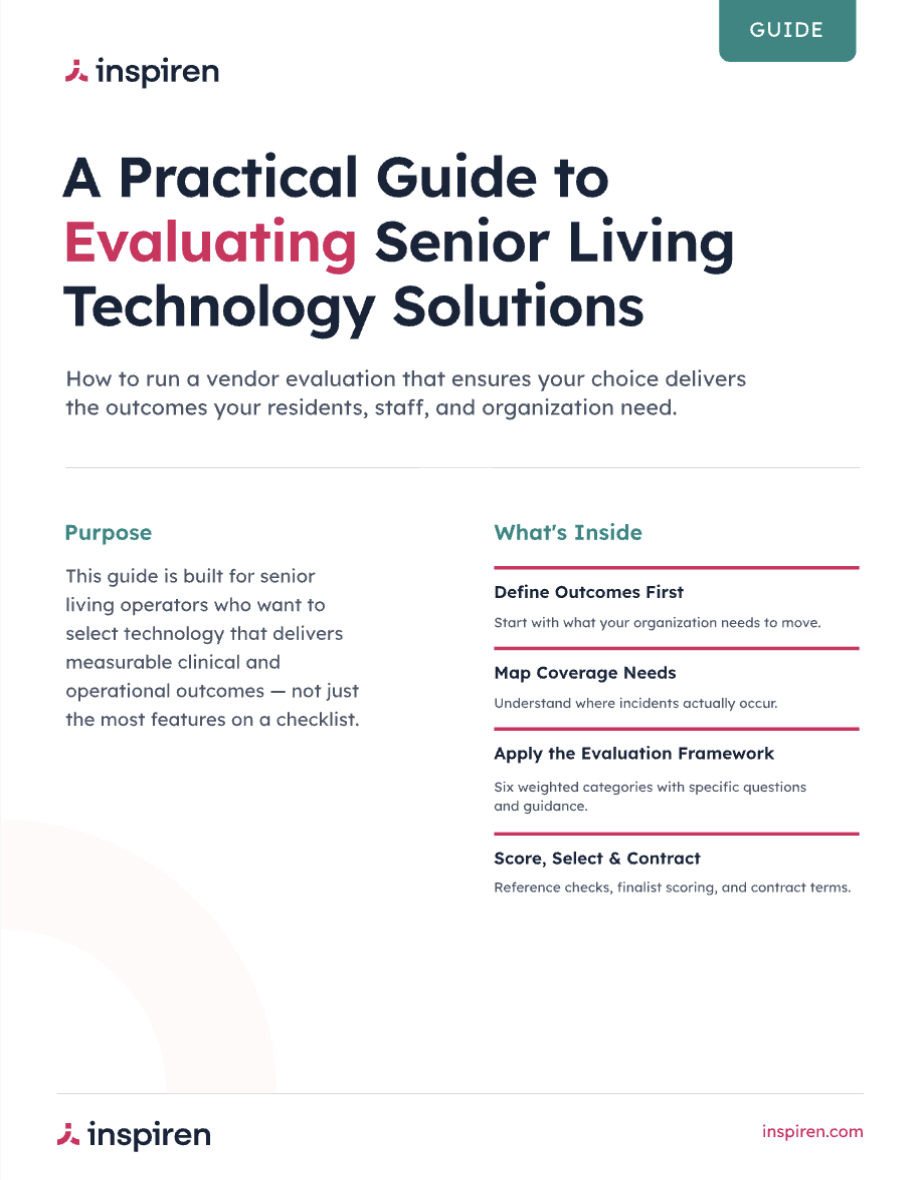
We’ve collected the insights from our own team of senior clinicians, previous operators and long-time industry experts to collate the most important evaluation factors into a single guide - designed to help operators get the very best solution for their needs. These five questions are the some of the ones most vendors hope you don't think to ask.
1. Where Does Your System Have No Coverage?
Every vendor will show you what their system does in a controlled demo. Fewer will tell you where their system has no coverage at all.
Make sure you push for specifics. Bathrooms are the most common uncovered area, and among the highest-risk. Falls happen in bathrooms, and residents wander into them at night. Yet sensor placement in bathrooms is often constrained by privacy concerns, installation requirements, or hardware design limitations.
A vendor who redirects this question is signaling a gap. The right answer is a clear account of physical coverage limitations and an honest description of exactly how the data around this activity is captured and logged.
2. When Staff Don't Log an Interaction, What Does Your System Show?
Documentation compliance is never 100%. Care gets delivered. The log entry doesn't happen. It's a reality in every community.
We recommend you make sure you understand this reality. Ask your vendor what the system shows when that happens. Does it display silence? Does it flag the gap? Can it distinguish between "care occurred but wasn't logged" and "no care occurred at all"? What is on their roadmap to address this (and by when!)?
A system that can't tell a documentation gap from a care gap creates real liability exposure. Worse, it can make your data look better than reality, which hides risk instead of showing it. Metrics that look strong only because the system can't detect gaps aren't metrics. They're blind spots.
3. What’s the Real Status of Your EHR Integrations?
Many vendors claim EHR integration. Far fewer have data flowing in both directions — information moving into the EHR and updates flowing back into the vendor's platform. And of the ones that do, fewer still have it live at scale. Don't just ask "is it bidirectional." Ask what's live today versus what's on the roadmap, and push for specifics: which data moves which direction, at which sites, and since when.
A vendor should be able to show real technical momentum. This means active engineering partnerships, infrastructure already built, and named pilot sites. HealthIT.gov defines interoperability as the ability to exchange information and use it once it's received, not simply move a file from one system to another.
"Integration" gets used loosely. Anything from a nightly CSV export to a live bidirectional API gets called the same thing. A vendor who's transparent about what's live vs. in progress, and can point to concrete proof of work, is more trustworthy than one who claims full bidirectionality with nothing to back it up.
4. Let’s Go Beyond the Technology - What Support is Available to Us After We Sign With You?
It’s one thing to have the technology, but implementing new solutions requires change management, training and ongoing partnership to ensure proper adoption and return on your investment.
Be sure to clarify what type of support your teams will get, and ask about the clinical strategy and expertise that can augment your own staff. Ask about the clinical credentials of the team that will be working with your DON. Find out how often your vendor will meet with clinical leadership to align on strategy and discuss outcomes.
Great partnership with a vendor means having a clear line of sight on what is making an impact. Deep industry expertise and collaboration with your own experts ensures that you have a mutual understanding of what success will look like. This should be a nonnegotiable.
5. What Does the Total Cost of Ownership Actually Look Like?
Technology pricing in senior living is notoriously difficult to decode. The base fee rarely represents total cost. Hardware replacement cycles, implementation, training, data exports, API access, support tiers, devices, and annual increases each carry fees that may not appear in the initial proposal.
Ask for a sample invoice from a comparable-sized community. Ask what's included in the base contract and what triggers an additional charge. Ask what happens to your data if you exit.
Total cost of ownership might look very different once you factor in hardware refresh cycles, per-integration fees, and year-over-year increases. The vendor with the lowest headline rate is rarely the lowest-cost option at year three.
Frequently Asked Questions
What should I ask a senior living technology vendor before signing a contract?
Start with the questions vendors hope you won't ask: where coverage gaps exist, what the system shows when staff don't document care, whether emergency calls function without internet, whether EHR integration is genuinely bidirectional, and what a real invoice looks like at a comparable community. These questions reveal how a system performs under real-world conditions, not demo conditions.
How do I verify that a vendor's EHR integration actually works?
Ask the vendor for a reference site using your specific EHR, then contact that site's clinical leadership directly. Ask whether the integration is live, bidirectional, and actively used by staff. Vendor-provided case studies confirm intent. A direct reference call confirms reality.
What does total cost of ownership mean for senior living technology?
Total cost of ownership (TCO) covers the base contract fee plus hardware replacement cycles, implementation and training costs, per-integration fees, support tier upgrades, annual rate increases, and data portability costs at contract exit. Requesting a sample invoice from a comparable community is the most reliable way to understand true three-year costs before signing.
Why do coverage gaps in bathrooms matter so much for fall risk?
Bathrooms combine water, hard surfaces, and low lighting with a resident who is often alone and moving without assistance. Falls are common in these spaces, and many technology systems have limited or no sensor coverage there because of privacy and installation constraints. Ask any vendor to describe their bathroom coverage honestly, rather than assume it matches their coverage everywhere else.
What's the difference between a documentation gap and a care gap?
A documentation gap means care was delivered but never logged. A care gap means the care never happened at all. A system that can't tell these apart treats both the same way, which can hide real risk behind data that looks fine on paper.
Get the Full Evaluation Framework
These five questions will surface the gaps most evaluations miss. But a complete vendor selection process goes further, covering clinical workflow fit, staff adoption, implementation timelines, security posture, and scalability. Download the evaluation guide here.
Ready to see how Inspiren answers every one of these questions? Book a demo